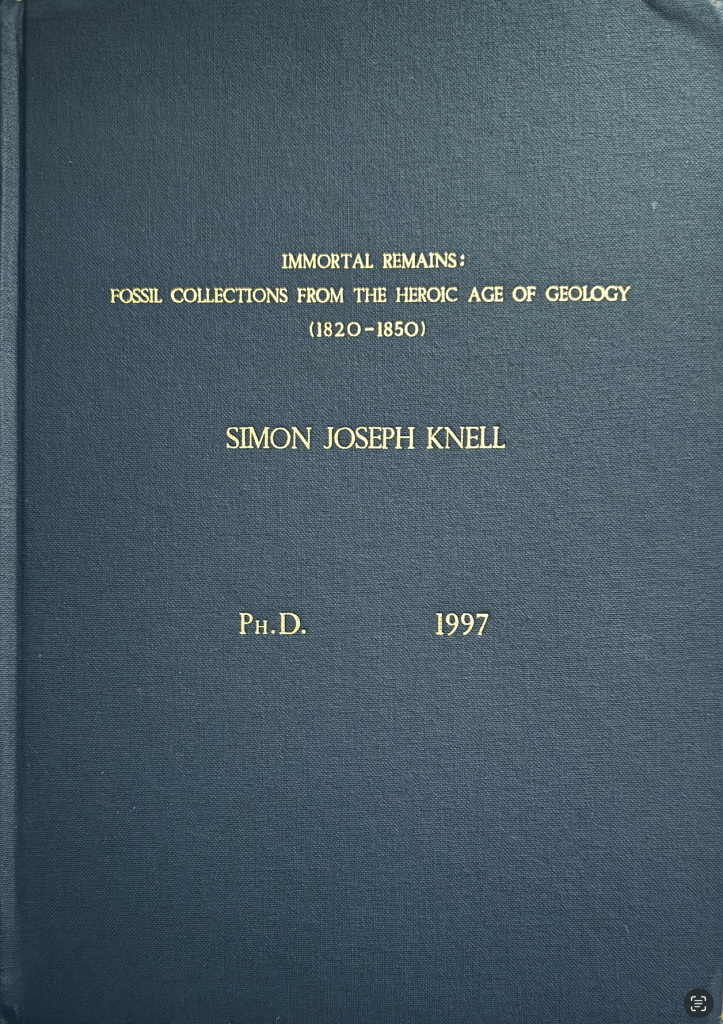
PhD Thesis 1997 (submitted 1996, bound March 1997), University of Keele, UK.
Access
Full access via the chapter links below.
Abstract
The philosophical movement of the 1820s brought with it a wave of collecting which in many parts of Britain was dominated by fossils. These collections survive today, but what do they represent? The supposition is that they are the product of science. The development of the Yorkshire philosophical societies and the Geological Survey provides an answer. The Yorkshire Philosophical Society established a powerbase which exploited contemporary social structures in order to pursue a geology of the county. Amongst its most remarkable exploits was the excavation of Bielsbeck Pleistocene site. John Phillips achieved the Society’s geological goal and built a career in this science; he was an exception as society experimented with meritocracy. In Whitby, the local society pursued fossils solely for territorial reasons, exposing the social, rather than scientific, motives for acquisition which underpinned the whole movement. The town took control of the growing commercial market in fossils. In Scarborough, collector rivalries created an entirely different collecting culture as the town discovered its fossil heritage. The heyday of the philosophical society as a scientific entity was short-lived and its place usurped by the rising Geological Survey which evolved a new collecting model as it mapped the South West, South Wales and the Malverns. This matched the increasing sophistication of geological investigation as it developed beyond the Survey’s initial stratigraphic or palaeontological interests to pursue evidence of environmental processes. The collections that resulted from this period are evidence of science but also of the culture which arose at the height of geology’s popularity. Science and collecting provided a route to immortality in a society preoccupied with fame. Fossil collections fed the contemporary popularity of geology, but were also created to preserve a cultural memory of it. As such they represent the material evidence of an ‘heroic age’.
Content
Preface
Archival Sources and Abbreviations
1. Rivals and monuments: philosophical societies and fossils in the 1820s
Discussion of the establishment of philosophical societies in Britain and particularly in Yorkshire, and in that county particularly in York, Whitby, Scarborough and Hull. An explanation of the centrality of the new and exciting science of geology to these enterprises.
2. Philosophers, patrons and slaves: the components of society fossil collecting
Explains how the philosophical societies, and particularly the Yorkshire Philosophical Society, were structured to enable collecting and museum building. The structure adopted in York would later shape the founding and organisation of the British Association for the Advancement of Science. This chapter also looks at the difficult lives of the early curators.
3. The problem of immediacy
These societies were in competition with each other and needed to act quickly to build their collections of fossils. This chapter explains how they did so.
4. Phillips’ elucidation of Yorkshire
The Yorkshire Philosophical Society wished for knowledge and in particular to understand and explain the geology of Yorkshire. This chapter looks at the journey of John Phillips, nephew of William Smith, who realised the society’s goal in the 1820s.
5. A market in Whitby saurians
Early nineteenth-century Yorkshire developed a highly competitive market in Yorkshire plesiosaurs, ichthyosaurs and crocodiles which were seen as being the great prizes for the new museums. The centre of the market was Whitby but it failed to control all the great fossils emerging from the cliffs.
6. Scarborough – the birth of a fossil locality
If Whitby was already known to hold potential as a great fossil locality at the beginning of the nineteenth century, the same could not be said of Scarborough, even if William Smith and John Phillips considered the town’s Castle Hill the key their cross country correlation of rocks. These two men ignited something of a fossil collecting craze in the town and as a result important fossil localities were discovered.
7. Bielsbeck – the legacy of Kirkdale
The Yorkshire Philosophical Society’s excavation for Pleistocene fossils and its dispute with the philosophers in Hull.
8. Geology and museums in transition
A look at what happened to the philosophical society museums as the movement fell into decline.
9. The nation claims provincial geology
In the 1830s an emergent national geological survey began a process of professionalising the practices of geology including the gathering of fossils. John Phillips is part of this transformation. I refer to this as a cultural revolution in the science in a chapter in Museum Revolutions. The focus of this chapter is on Devon and Cornwall, looking in more detail at the field practices and collecting. This was still a period when the science was dependent on private collectors.
10. Collecting integrated
Collecting becomes integrated into the practices of the new Geological Survey of Great Britain. Focusing on the Survey’s work in Wales and the Malverns, this chapter shows how the Survey achieved a greater level of scientific rigour.
11. The nationalisation of British palaeontology
In the early 1840s, the Survey continues to grown and dominate the stratigraphic practices that dominated and defined ‘English geology’. Here I show how fossil collecting became more professionalised. I also look at Phillips’ career troubles as he faced new challenges from a new generation of naturalist-palaeontologists. It looks at the Survey in Wales, Ireland and the Malverns and considers where the national geological collection should be located.
12. Fossil collections: the foundations of an heroic age?
My conclusions…
 Simon Knell